

Listen to the original investigation:
The Daily, "The Secret Spy Network Feeding Russia's War Machine", featuring New York Times investigative reporter Jane Bradley.
Apple Podcasts: https://podcasts.apple.com/us/podcast/the-secret-spy-network-feeding-russias-war-machine/id1200361736?i=1000783289217�
Pocket Casts: https://pocketcasts.com/podcast/the-daily/4eb5b260-c933-0134-10da-25324e2a541d�
31 minutes.
IntelligenceAnalysis.org Assessment
15 August 2026
Executive Summary
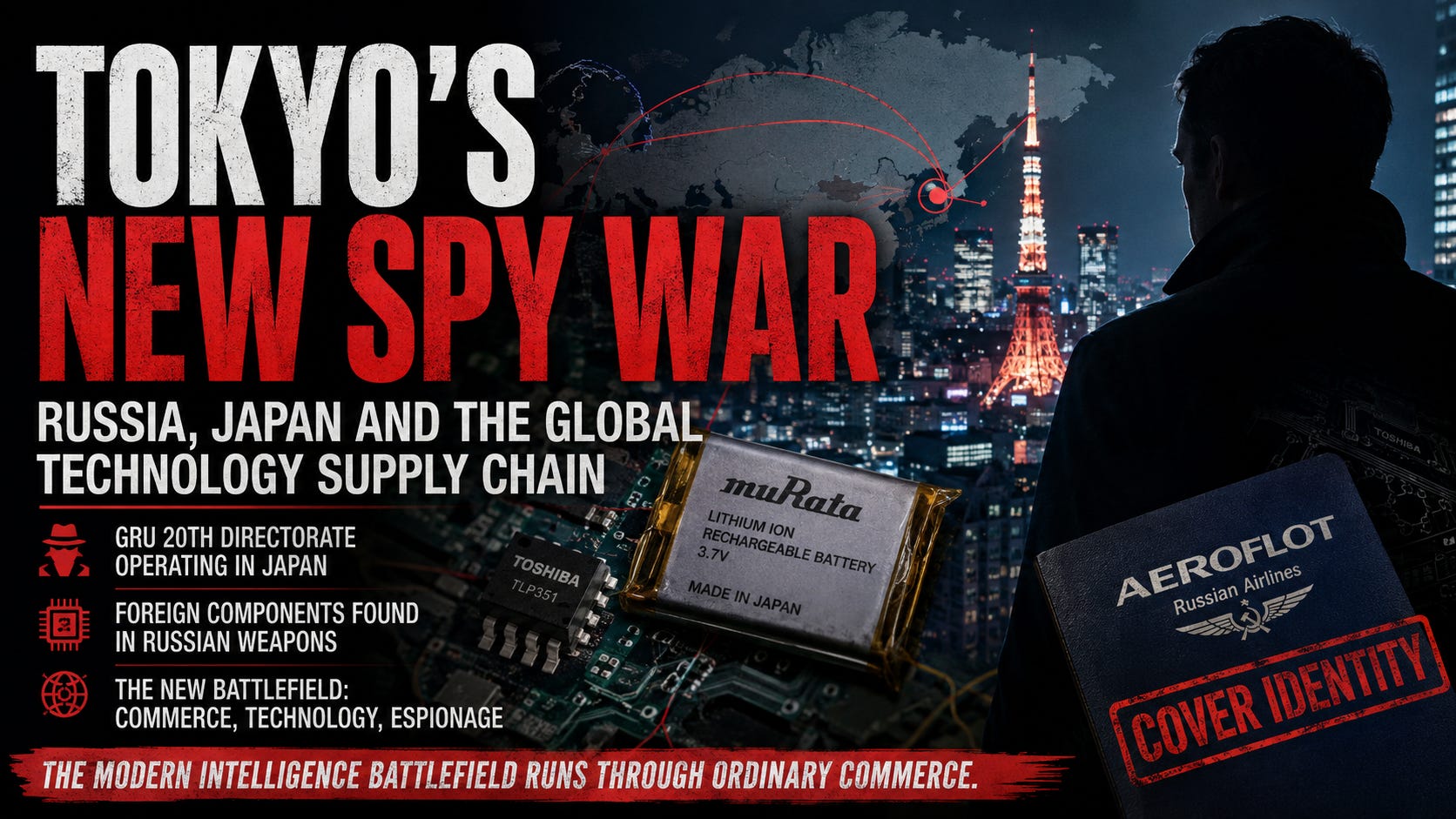
A July investigation by The New York Times exposed an alleged Russian military-intelligence operation operating from Japan to acquire dual-use technology for Russia's war effort. The investigation identifies a previously little-known GRU formation, referred to as the 20th Directorate, and alleges that its Tokyo operation was led by GRU officer Maksim Filchenkov while operating under Aeroflot cover. The reporting was based on information from current and former officials from five Western intelligence agencies.
The immediate story is significant.
The wider story may be considerably more important.
Evidence demonstrates that foreign-made components continue to appear extensively inside Russian weapons despite Western sanctions and export controls. Ukraine's military intelligence maintains an open database listing 5,816 foreign-produced components identified across 202 Russian weapon systems, including Japanese components.
The strategic implication is that Russia's wartime procurement problem is not simply one of espionage.
It is a supply-chain intelligence problem.
Russia does not necessarily need to steal a complete weapons design. It can seek access to the industrial ecosystem that produces the components, materials, machinery and technologies required to sustain weapons production.
This creates a vulnerability that conventional sanctions regimes struggle to address:
legitimate manufacturer → legitimate distributor → intermediary → third-country transaction → Russian procurement network → defence industry.
Japan is particularly interesting because its geographical position, advanced industrial base, proximity to Russia, China and North Korea, extensive commercial networks and historically constrained counter-espionage architecture combine to create an unusually valuable environment for intelligence collection and technology acquisition.
The Royal United Services Institute has explicitly described Japan's historical vulnerability to foreign espionage as a former "spy paradise", while identifying the country's intelligence reforms as a major development in its security architecture.
However, the available evidence does not justify describing Tokyo as the new Berlin or Vienna.
The comparison is useful as an analytical framework, but the underlying environments are materially different.
The more useful hypothesis is that Tokyo may represent a 21st-century intelligence crossroads, in which espionage, commercial procurement, technology acquisition, sanctions circumvention and supply-chain exploitation increasingly converge.
Japan itself appears to recognise the changing environment. Its intelligence reforms are designed to strengthen central coordination, collection, assessment and analysis, while the government is preparing a second stage involving counter-espionage legislation.
Key Judgements
1. Russian intelligence activity in Japan appears to extend beyond traditional espionage.
The reported 20th Directorate operation appears focused on acquiring technological capability through commercial and intermediary networks rather than simply obtaining classified information.
Confidence: Moderate to High.
The specific organisational details rely heavily on the NYT investigation and intelligence-source reporting. The broader phenomenon of foreign components appearing in Russian weapons is supported by separate evidence.
2. Russia's ability to obtain foreign technology represents a systemic sanctions-enforcement problem rather than an isolated espionage failure.
Ukraine's component database identifies thousands of foreign-produced items inside Russian weapons, including Japanese technology.
Confidence: High for the existence of foreign components. Moderate for the precise scale and mechanisms by which individual components reached Russia.
3. The critical vulnerability may lie in commercial due diligence rather than conventional counter-intelligence alone.
If the reported procurement model is representative, Russia can exploit legitimate international commerce without requiring every intermediary to knowingly participate in Russian intelligence activity.
This shifts the security problem from:
"Find the spy."
towards:
"Identify the transaction, network or supply-chain pattern that indicates an abnormal end user."
Confidence: Moderate.
This is an IA analytical judgement, not a claim that particular companies or intermediaries knowingly facilitated Russian intelligence activity.
4. Japan's intelligence reforms are strategically significant.
RUSI describes the creation of a National Intelligence Council and National Intelligence Bureau as the first stage of a broader intelligence reform programme. The second stage is an anti-spy law planned for later in 2026.
Confidence: High.
5. Tokyo should not yet be characterised as a direct modern equivalent of Cold War Berlin or Vienna.
The historical comparison is useful because all three locations can be examined as potential intelligence crossroads, but their strategic mechanisms differ.
Berlin and Vienna were shaped by Cold War geography, physical proximity between opposing blocs, diplomatic concentration, human intelligence requirements and the movement of people and information across divided Europe.
Tokyo's potential significance lies elsewhere:
advanced technology + strategic geography + commercial connectivity + intelligence competition + supply-chain access.
Confidence: Moderate.
1. The Original Investigation
The central reporting was published by The New York Times in July 2026 by Jane Bradley, Michael Schwirtz and Adam Goldman.
The investigation describes a Russian military-intelligence operation in Japan centred on the GRU's alleged 20th Directorate.
According to the reporting, GRU officer Maksim Filchenkov operated in Tokyo under Aeroflot cover and arrived in the role in February 2024.
The investigation was based on information from current and former officials associated with five Western intelligence agencies.
The precise publication date is reported variously as 12 and 13 July. This appears to reflect publication and international reporting time differences rather than a substantive discrepancy.
Following publication, Japanese sources and a Ukrainian intelligence official confirmed that Filchenkov had departed Japan.
That provides evidence of an operational consequence following exposure of the reported network.
It does not, however, independently establish every allegation contained in the NYT investigation.
2. The Component Problem
The strongest independent evidence concerns the end product.
Ukraine's military intelligence maintains an open database identifying foreign-produced components found in Russian weapons.
The database lists:
5,816 foreign components
across:
202 Russian weapon systems.
The database includes Japanese-produced technology.
One identified example is a Murata battery pack found in the Russian S8000 "Banderol" missile. Other foreign components identified in the same weapons system include Toshiba phototransistors.
These findings matter because they separate two questions.
Question 1
Is foreign technology reaching Russian weapons?
There is substantial evidence that it is.
Question 2
Is the Russian intelligence network identified by the NYT responsible for the majority of that flow?
That has not been established by the available open-source evidence.
That distinction is critical.
The existence of Japanese or other foreign components inside Russian weapons does not automatically establish espionage, deliberate sanctions evasion or corporate complicity.
3. Mechanical Interpretation
The reported procurement architecture suggests a model based upon network exploitation rather than single-point espionage.
The apparent mechanism is:
Target technology
↓
Commercial acquisition
↓
Intermediary or distributor
↓
Third-country movement
↓
Russian procurement network
↓
Russian defence-industrial integration
The importance of this structure is that each individual transaction may appear relatively ordinary.
A Japanese manufacturer may legitimately sell a component.
A distributor may legitimately sell to another company.
A logistics provider may legitimately transport the goods.
A financial institution may legitimately process payment.
No individual participant necessarily needs to see the complete intelligence picture.
The intelligence service's advantage comes from seeing the network as a whole.
That is fundamentally different from the classic Cold War model of an intelligence officer recruiting an individual with access to a secret.
4. Why Japan?
Japan's importance is not simply that it is technologically advanced.
Its value derives from the combination of several characteristics.
Strategic geography
Japan sits close to Russia, China and North Korea and is deeply integrated into the US-led Indo-Pacific security architecture.
Its geographical position provides access to multiple strategic theatres.
Industrial capability
Japan possesses sophisticated capabilities across electronics, precision engineering, sensors, materials, machine tools and other dual-use sectors.
These capabilities make Japanese industry relevant to a state seeking technological substitutes under sanctions.
Commercial connectivity
Japan is deeply integrated into Asian and global supply chains.
That creates enormous legitimate flows of technology and goods.
The same connectivity that produces economic efficiency can create opportunities for intelligence-enabled procurement.
Counter-intelligence history
Japan has historically operated without some of the conventional intelligence and counter-intelligence institutions found in other major powers.
RUSI describes Japan as having endured a society-wide vulnerability to foreign espionage and influence and identifies the current reforms as a major attempt to correct that weakness.
That environment is now changing.
5. Tokyo, Berlin and Vienna
The Cold War comparison is useful, but only if applied carefully.
Berlin and Vienna were intelligence crossroads because they were physical crossroads of competing systems.
Tokyo may be developing into something different:
a technological and commercial crossroads of competing strategic systems.
Berlin and Vienna offered intelligence services geographical access.
Tokyo potentially offers something additional:
access to capability.
Cold War espionage often sought:
information.
Contemporary strategic competition increasingly seeks:
capability.
A modern intelligence service may therefore gain more by understanding a supply chain than by obtaining a classified document.
The target becomes the ecosystem:
manufacturer → distributor → logistics → finance → intermediary → end user.
That is why the business due-diligence question raised during the Daily discussion deserves serious attention.
If commercial due diligence fails to identify abnormal procurement patterns, an intelligence service may be able to exploit legitimate commerce without requiring every participant to be a knowing accomplice.
6. Japan's Intelligence Response
Japan's response is potentially one of the most consequential elements of this story.
RUSI's June 2026 analysis states that legislation establishing a National Intelligence Council and National Intelligence Bureau passed Japan's Upper House on 27 May, with the new structures intended to strengthen centralisation and coordination of intelligence activity. RUSI describes an anti-spy law as the second stage of reform, planned for later in 2026.
The significance goes beyond bureaucratic restructuring.
It suggests that Japan increasingly views foreign espionage, influence and economic-security threats as interconnected problems requiring stronger national intelligence coordination.
The timing is notable.
12/13 July: NYT investigation becomes public.
24 July: reporting emerges that the alleged GRU officer has left Japan.
31 July: Japan's new intelligence architecture begins operating.
We should not infer causation from this chronology.
The reform process was already underway before the NYT investigation.
The sequence does, however, illustrate how rapidly the strategic environment is changing.
7. What We Do Not Know
Several major questions remain unresolved.
We do not know the true scale of the 20th Directorate.
The organisation is described as highly secretive. Open-source information about its structure, personnel and activities remains limited.
We do not know how much of Russia's foreign-component acquisition is intelligence-directed.
The existence of foreign components in Russian weapons does not automatically establish GRU involvement.
Some acquisition may occur through ordinary commercial activity, opportunistic sanctions evasion or procurement networks unrelated to intelligence services.
We do not know how many Japanese companies are knowingly involved.
The available evidence does not justify treating Japanese manufacturers or distributors as complicit merely because their components have appeared in Russian weapons.
We do not know whether Japan is uniquely vulnerable.
The evidence demonstrates a Japanese problem.
It does not yet demonstrate that Japan is the dominant global procurement hub for Russian military technology.
We do not know whether the 20th Directorate represents a wider Russian model.
This may be a dedicated Japan operation, or Japan may be one node within a much larger Russian global procurement architecture.
That question deserves separate research.
8. Analytical Judgement
Assessment
Russia is increasingly treating the global commercial technology ecosystem as an intelligence environment.
The reported GRU operation in Japan should therefore not be viewed solely as an espionage story.
It is better understood as evidence of the convergence of:
intelligence operations
commercial procurement
sanctions circumvention
supply-chain exploitation
technology competition
defence-industrial resilience
The critical vulnerability is not necessarily the existence of a Russian spy in Tokyo.
It is the possibility that a sophisticated intelligence organisation can operate inside legitimate international commerce.
That creates a fundamentally different counter-intelligence challenge.
9. Potentially Actionable Implications
Governments
Governments should move beyond static lists of sanctioned entities and develop risk-based supply-chain intelligence.
High-risk transactions should be evaluated using:
unusual routing
newly established intermediaries
sudden changes in purchasing patterns
unexplained increases in sensitive-technology exports
unusual end-user structures
high-risk jurisdictional combinations
inconsistent corporate histories
connections between apparently unrelated companies
The objective should be to identify patterns, not merely prohibited names.
Manufacturers and distributors
Manufacturers should know where their products ultimately go.
Where components are technically capable of military application, end-user diligence should extend beyond the immediate customer.
A legitimate customer should not automatically be treated as a legitimate end user.
Companies should maintain mechanisms for investigating reports that their components have been recovered from weapons systems.
Financial institutions
Financial institutions may possess information that manufacturers and governments do not.
Transaction patterns can expose networks that individual export transactions conceal.
This suggests potential value in closer integration between:
financial intelligence + customs data + export-control data + corporate ownership data + intelligence reporting.
Intelligence services
Counter-intelligence organisations should increasingly examine commercial networks as intelligence terrain.
The relevant question is no longer simply:
"Who is the foreign intelligence officer?"
It is also:
"What network does that officer interact with, and what capability does the network provide?"
10. Indicators to Watch
The following indicators would strengthen the assessment that Japan is becoming a significant technology-procurement hub for Russian intelligence:
1. Additional Russian intelligence officers identified in Japan.
2. Additional Japanese-origin components identified in recently manufactured Russian weapons.
3. Evidence connecting Japanese components to specific third-country intermediaries.
4. Japanese investigations identifying companies or individuals involved in deliberate sanctions circumvention.
5. Similar Russian procurement operations discovered in South Korea, Taiwan, Singapore or other advanced Asian economies.
6. Evidence that the 20th Directorate operates beyond Japan through a network of regional procurement cells.
7. Japanese counter-espionage legislation becoming substantially broader than existing protections for classified government information.
8. Expansion of Japanese intelligence cooperation with the United States, Australia and European partners around economic-security intelligence.
11. Intelligence Gaps
The most important intelligence gaps are:
20th Directorate
organisational structure
geographic footprint
command relationships
personnel
previous operations
Procurement
principal intermediaries
third-country routing
financial mechanisms
logistics providers
corporate ownership structures
Technology
which Japanese components are genuinely critical
which are commercially substitutable
which components are being deliberately targeted
whether Russia has developed domestic alternatives
Counter-intelligence
extent of Japanese knowledge before July 2026
number of Russian intelligence officers operating in Japan
Japanese investigations already underway
degree of intelligence sharing with allied services
12. Final Assessment
The available evidence does not yet justify describing Tokyo as the new Berlin or Vienna.
The comparison is useful because it highlights a recurring intelligence principle: geography can concentrate strategic opportunity.
But the nature of that opportunity has changed.
Berlin and Vienna were Cold War intelligence crossroads because geography concentrated opposing intelligence services, diplomats, military forces, human networks and information flows.
Tokyo may be emerging as a different kind of intelligence crossroads because geography, technology, commerce and strategic competition intersect there.
That is a distinctly 21st-century intelligence environment.
The most significant development may therefore not be the discovery of one Russian officer operating from a Tokyo office.
It may be the recognition that the modern intelligence battlefield increasingly runs through ordinary commerce.
The spy may be in the office.
The target may be a semiconductor.
The route may run through a third country.
The transaction may look legitimate.
And the ultimate battlefield effect may occur thousands of kilometres away.
That is the fundamental challenge exposed by this case.
Russia does not need to steal everything it needs.
It needs to remain connected to the systems that manufacture it.
IntelligenceAnalysis.org Position
This assessment builds upon reporting originally developed by The New York Times. We do not claim ownership of that investigation.
Our purpose is to independently examine the available evidence, identify what can and cannot be established, and assess the wider implications.
Where the original reporting survives scrutiny, it deserves to be read and credited.
Where evidence remains uncertain, that uncertainty is retained.
Listen to the original investigation:
The Daily, "The Secret Spy Network Feeding Russia's War Machine", featuring New York Times investigative reporter Jane Bradley.
Apple Podcasts: https://podcasts.apple.com/us/podcast/the-secret-spy-network-feeding-russias-war-machine/id1200361736?i=1000783289217�
Pocket Casts: https://pocketcasts.com/podcast/the-daily/4eb5b260-c933-0134-10da-25324e2a541d�
31 minutes.
We are not trying to be first. We are trying to be right.
Not louder. Not faster. Better.