

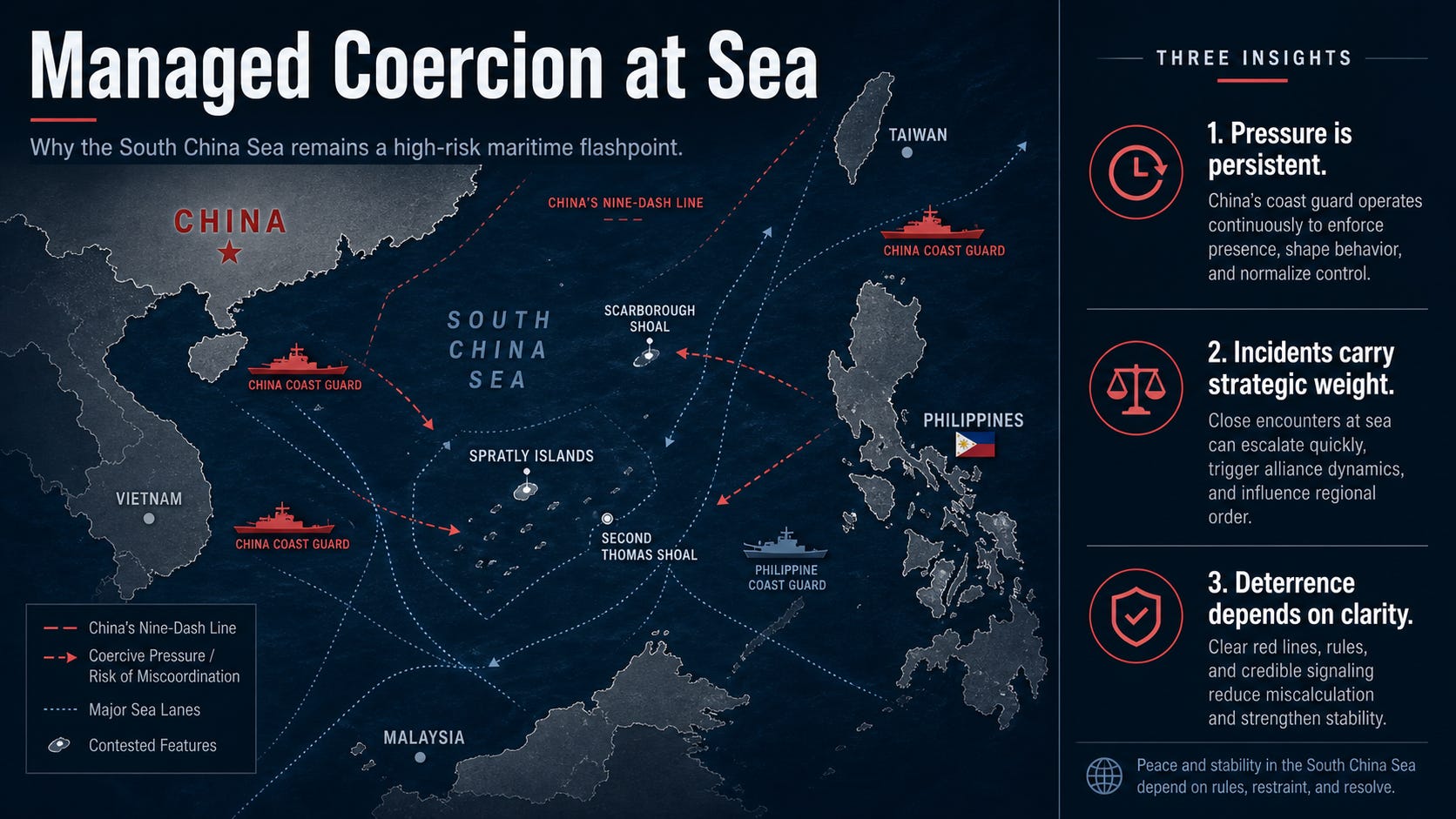
The most useful way to understand the South China Sea right now is not as a dispute waiting for a breakthrough, but as a managed coercion environment that is becoming more dangerous by repetition. The pattern this week, and for much of the past two months, is one of sustained pressure between China and the Philippines, layered over a broader alliance response that is making the dispute more international, more visible, and harder to contain.
That matters because the South China Sea is no longer just a legal or historical argument about sovereignty. It is a live test of how far states can push each other without triggering a serious incident. The central risk is not that a war starts on purpose. It is that a collision, interception, water cannon incident, or misread manoeuvre creates a crisis that none of the participants fully intended.
What makes the current phase especially important is that coercion is now being used as a signalling tool on all sides. China continues to apply pressure through coast guard activity, maritime militia behaviour, and tactical presence around contested features. The Philippines continues to assert access and resupply rights. Outside partners, including the United States and other allies, are increasingly visible in the area, which raises the political cost of escalation but also makes the theatre more crowded.
That crowding is strategic, not accidental. Beijing appears determined to make its claims routine through persistent maritime activity rather than dramatic military moves. Manila, by contrast, is trying to avoid normalization of Chinese control while not provoking a direct military clash. The result is a contest in which both sides are trying to shape the baseline of acceptable behaviour, and each new encounter becomes part of that struggle.
The most important shift is that the South China Sea is becoming a place where tactical incidents now carry strategic meaning. A water cannon episode is no longer just a maritime harassment story. It is a test of alliance credibility, domestic political resolve, and whether the region’s rules are actually enforceable. That is why the latest CSIS reporting matters. It shows a conflict that is not frozen, but active enough to remain unstable and ambiguous.
This is also why the alliance dimension cannot be treated as a separate track. Multilateral naval exercises, public support from regional partners, and symbolic demonstrations of presence are all meant to deter coercion, but they can also deepen the sense in Beijing that it is facing a coordinated challenge. That makes the environment more brittle. Deterrence works best when it is clear and credible. In a crowded maritime zone, clarity can be difficult to maintain.
The Philippines sits at the center of this dynamic because it is both the immediate target of pressure and the state most exposed to the consequences of escalation. Manila cannot simply withdraw without accepting a loss of position, but it also cannot match China ship for ship. That leaves it dependent on a mix of legal argument, alliance support, coast guard resilience, and public diplomacy. This is a difficult posture, and one reason the South China Sea remains a serious risk theatre rather than a routine background issue.
China’s strategy appears to be calibrated to avoid a decisive rupture while still gradually shifting the facts on the water. That is a classic coercive pattern. It does not require open conflict. It requires enough pressure to force the other side to spend time, money, and political capital responding. Over time, that kind of pressure can produce strategic gains even without a formal victory. It also increases the chance that a local commander or crew member makes a mistake with wider consequences.
The wider implication is that the South China Sea is now part of a larger contest over the credibility of international rules. If coercive behavior becomes normal and unresolved, then legal claims matter less than persistence and capacity. That does not mean law disappears. It means law becomes one instrument among many in a contest where presence, perception, and endurance are often more decisive.
For shipping and commercial actors, the key lesson is that this is not a problem that can be solved by assuming the issue is only diplomatic. Even when open conflict is absent, maritime friction can affect routing confidence, insurance assumptions, and operational planning. Businesses tend to focus on the direct cost of disruption, but the deeper effect is uncertainty. Uncertainty forces contingency planning, and contingency planning increases cost.
That same logic applies to strategic messaging. When allies conduct visible exercises or issue statements of support, they are not only trying to reassure Manila. They are also trying to shape Beijing’s calculations about the risks of escalation. But because the contest is occurring in close quarters, every show of support can be read in multiple ways. That is what makes the South China Sea so difficult: each side believes it is signalling restraint or resolve, while the other may see provocation.
The question going forward is whether the region can remain in a state of managed friction without crossing into a genuine crisis. The near-term answer is probably yes, but only in the narrow sense that none of the actors appear eager for war. The harder truth is that restraint itself is becoming more expensive. The more often these incidents occur, the more likely it becomes that one of them produces a political or military response that is harder to unwind.
The South China Sea also matters because it is a proxy for a bigger strategic reality. The region shows how power is being exercised in the current international system: not always through dramatic invasions or formal declarations, but through persistent pressure, legal ambiguity, and the slow normalization of risk. That makes it one of the clearest examples of the new maritime security environment.
What should be watched next is less a single headline than a pattern. Any new encounter between Chinese and Philippine vessels, any risky air interception, any change in allied naval presence, and any shift in domestic political rhetoric in Manila or Beijing could move the situation quickly. The danger is not just escalation. It is miscalculation inside a system where both sides have grown used to operating at the edge of it.
Why It Matters
This topic works because it gives you a clean, focused strategic narrative. The South China Sea is specific enough to support a sharp article, but broad enough to connect to alliance politics, maritime trade, and regional order. It is also visually strong, which makes it useful for Substack and for a podcast summary.
For your audience, the core judgment is simple: the South China Sea is no longer a distant dispute. It is an active coercion zone where small incidents now carry larger strategic weight. That is what makes it worth a full focus piece.