

IntelligenceAnalysis.org — Intelligence Assessment
Prepared: 18 August 2026
Assessment: Financial / Economic Security
Confidence: Moderate
Executive Assessment
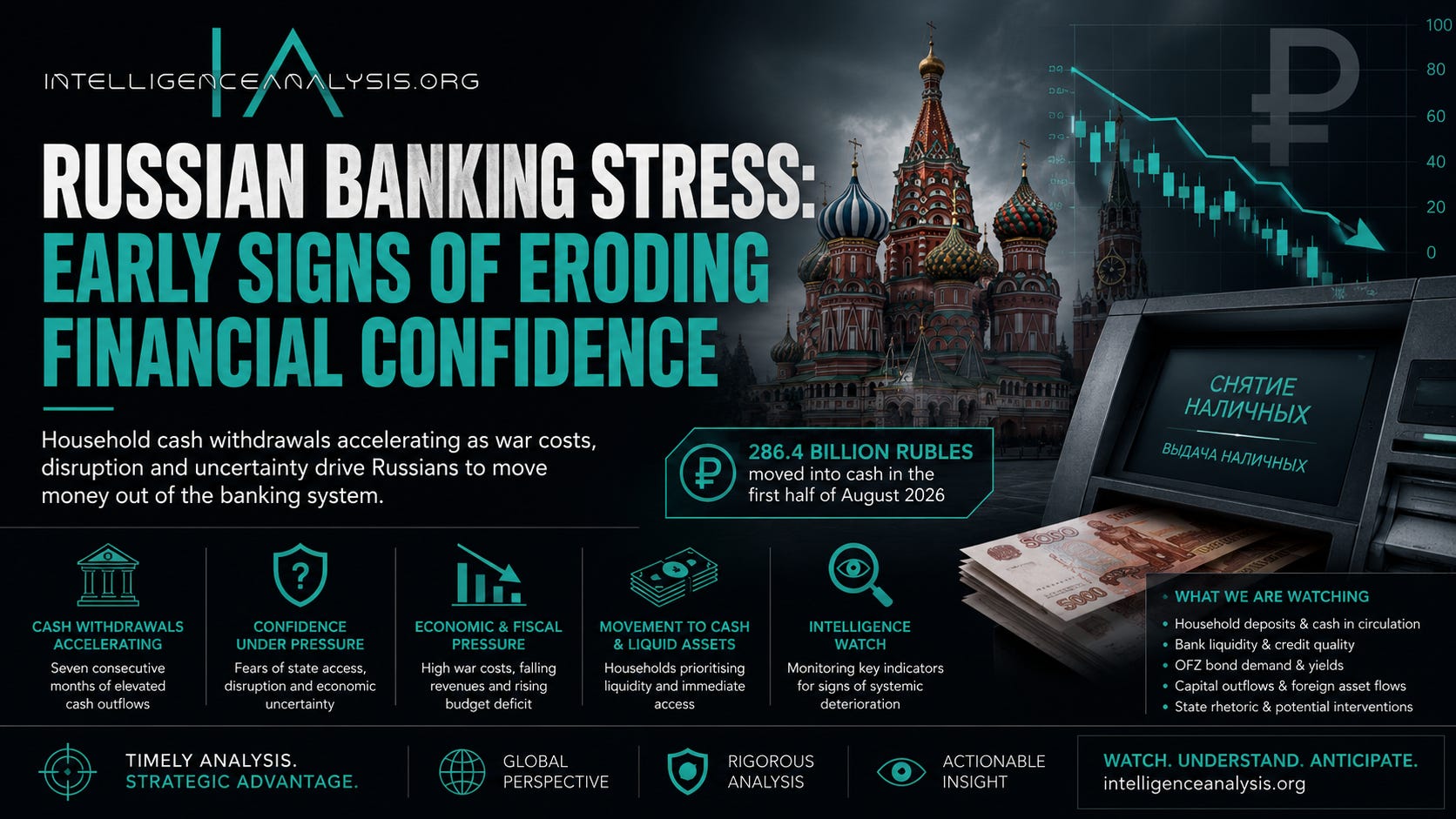
Russia is experiencing a sustained acceleration in cash leaving the formal banking system, with the first two weeks of August producing an estimated 286.4 billion rubles (approximately US$3.4 billion) increase in cash circulation. This follows approximately 7.3 billion dollars in July and more than 4.5 billion dollars in June, according to reporting based on Russian Central Bank data. The current pattern represents the seventh consecutive month of elevated cash outflows.
The immediate significance is not that Russia is experiencing an established banking run. There is insufficient evidence to support that conclusion.
The more important indicator is behavioural: Russian households appear increasingly willing to move wealth from deposits into physical cash or other forms of immediately accessible capital. This is occurring against a backdrop of wartime economic pressure, elevated bad debt, tight monetary conditions, fiscal deterioration, infrastructure disruption and growing public discussion about whether private savings could ultimately be mobilised to support the war economy.
Our assessment is that the developing phenomenon represents an emerging confidence problem within Russia's financial system, rather than an acute systemic banking crisis at present.
The risk is that continued withdrawals become self-reinforcing.
Key Judgements
1. Cash withdrawal activity is materially elevated.
The 286.4 billion ruble increase during the first half of August continues a trend that has persisted for seven months. July reportedly produced more than 620 billion rubles of additional cash circulation, while cumulative cash leaving the banking system during 2026 has exceeded 2.4 trillion rubles.
2. Fear of state intervention is one driver, but not the only one.
Reporting increasingly links withdrawals to fears that the Kremlin could eventually mobilise private deposits to finance the war. Those fears have some basis in the Russian political information environment: Communist Party leader Gennady Zyuganov publicly proposed using a portion of household and corporate deposits to support the economy and state finances in June.
However, alternative explanations remain significant. Russian banks have also reported increased demand for physical cash amid repeated internet shutdowns, tax concerns and uncertainty over electronic payments.
3. The banking system is already operating under liquidity pressure.
The Bank of Russia previously forecast a structural liquidity deficit in 2026, with cash in circulation identified as one of the principal sources of liquidity outflow. Its February forecast placed the expected structural deficit at approximately 1.9–3 trillion rubles.
4. The interaction between household behaviour and wartime finance is potentially more important than either factor independently.
Household withdrawals reduce the liquidity available to banks. Banks are simultaneously carrying significant wartime lending exposure and deteriorating credit quality. If liquidity becomes increasingly constrained, banks may have less capacity to absorb additional government borrowing or purchase Russian sovereign debt.
5. This could become a problem for the Kremlin even without a conventional bank run.
Russia's wartime financial model depends heavily on the domestic financial system's ability to recycle household and corporate savings into lending and government securities. A sustained preference for cash or external assets weakens that mechanism.
What Is Happening?
The most significant immediate indicator is the continuing movement of money from bank accounts into physical cash.
During the first two weeks of August, cash in circulation increased by 286.4 billion rubles. This followed record or near-record monthly outflows in June and July.
The trend matters because it is occurring outside the normal seasonal pattern associated with Christmas or other predictable periods of elevated cash demand.
The Bank of Russia's own published statistical programme provides additional evidence that monetary and banking-system data are being closely monitored, including forthcoming releases covering the banking-system balance sheet, monetary aggregates, deposits and liquidity indicators.
The evidence therefore supports a straightforward observation:
Russian households are increasingly choosing liquidity and physical possession of money over leaving funds inside the formal banking system.
The reasons are more complicated.
Why Are Russians Withdrawing Their Money?
1. Fear of state mobilisation of private savings
This is currently receiving considerable attention.
In June, Communist Party leader Gennady Zyuganov publicly argued that approximately 130 trillion rubles held by Russian households and businesses could potentially be mobilised to support the economy and state finances. He reportedly suggested that around 30 trillion rubles could be mobilised quickly and argued that wartime presidential authority could facilitate such a measure.
There is no evidence that the Kremlin has decided to confiscate ordinary Russian household deposits.
That distinction is critical.
However, perceived future risk can change behaviour before a policy actually exists.
The relevant analytical question is therefore not:
Will Moscow confiscate deposits?
It is:
Do Russian depositors increasingly believe that Moscow might do so?
If the answer becomes yes, the resulting behavioural response can itself create financial stress.
2. Fear of disrupted access to electronic money
There is a less politically dramatic explanation.
Russia has experienced repeated internet disruptions associated with Ukrainian drone activity and security measures. Russian banking executives have reported increased demand for physical cash because consumers and businesses fear losing reliable access to electronic payment systems.
This explanation should not be dismissed.
Indeed, it provides an important alternative hypothesis: some of the cash withdrawal may represent precautionary liquidity rather than rejection of banks themselves.
That distinction matters enormously.
A citizen withdrawing €1,000-equivalent in cash because mobile internet is unreliable is behaving differently from a citizen withdrawing €1,000 because they believe the state may seize their deposit.
The observable behaviour is similar.
The underlying signal is not.
The Broader Financial Context
The cash withdrawals are occurring against a deteriorating macro-financial backdrop.
Russia's 2026 fiscal position has come under increasing pressure from war expenditure and weaker energy revenues. Earlier forecasts indicated that the budget deficit could rise substantially above the government's original target, while liquid fiscal reserves were expected to decline.
At the same time, Russian economic officials and economists have become increasingly concerned about the interaction between high interest rates, declining investment and wartime spending.
The dismissal of VEB chief economist Andrei Klepach after his warnings about Russia's economic trajectory is particularly notable. Klepach reportedly argued that Russia was losing the longer-term economic and technological competition and warned of severe consequences from prolonged wartime pressure.
This does not demonstrate an imminent financial collapse.
It does demonstrate that concern about the sustainability of the wartime economic model exists within Russia's own economic establishment.
Analytical Model
The emerging risk can be represented as a feedback loop:
War expenditure
↓
Fiscal and monetary pressure
↓
Higher household and corporate uncertainty
↓
Movement from deposits into cash / external assets
↓
Reduced banking-system liquidity
↓
Greater pressure on banks and domestic debt markets
↓
Higher perceived financial risk
↓
Further precautionary withdrawals
The critical point is the potential transition from rational precautionary behaviour to collective confidence deterioration.
That transition does not require everyone to believe the banking system is collapsing.
It only requires enough depositors to believe:
I would rather have my money available to me than leave it somewhere I cannot be certain I will be able to access it later.
What Would Confirm Escalating Banking Stress?
The current evidence does not justify calling this a systemic banking crisis.
Several indicators would materially change that assessment.
Indicators to watch
Household deposits
Sustained net contraction in household deposits.
Increasing movement from fixed-term deposits into demand deposits or cash.
Accelerating withdrawals across multiple major banks rather than concentration in individual institutions.
Bank liquidity
Rapid growth in the structural liquidity deficit.
Increased reliance on Central Bank liquidity facilities.
Rising interbank funding stress.
Increasing repo dependence.
Credit quality
Rapid growth in non-performing loans.
Increasing restructuring or refinancing of corporate debt.
Bank provisioning increases.
Government-directed support for strategically important borrowers.
Sovereign financing
Weakening demand for OFZ government bonds.
Rising yields required to attract domestic buyers.
Increasing dependence on state-controlled banks to absorb government debt.
Capital flight
Increasing transfers by Russian households or companies to foreign brokers.
Increasing demand for foreign currency or other offshore assets.
There is already evidence that Russian households transferred almost 600 billion rubles to foreign brokers between December 2024 and June 2026, according to Ukrainian intelligence reporting cited in recent coverage.
State intervention
Restrictions on withdrawals.
New capital controls.
Mandatory conversion of deposits.
Direct mobilisation of household savings.
Emergency bank recapitalisation.
Government guarantees expanding materially beyond existing mechanisms.
Any combination of these indicators would increase our assessment of systemic risk.
Alternative Explanations
The current situation should not be interpreted through a single causal narrative.
Hypothesis A — Fear of deposit seizure
Assessment: Plausible.
Political discussion of mobilising private deposits provides a credible information trigger. However, there is currently no evidence of a government decision to confiscate ordinary household savings.
Hypothesis B — Precautionary cash holdings
Assessment: Highly plausible.
Internet disruption and concerns about payment accessibility provide a non-political explanation for at least part of the cash movement.
Hypothesis C — General economic pessimism
Assessment: Plausible and increasingly relevant.
War expenditure, fiscal deterioration, high interest rates and concerns about future economic conditions may be encouraging households to maximise liquidity.
Hypothesis D — Emerging systemic banking confidence crisis
Assessment: Not yet demonstrated.
The evidence is moving in this direction, but the available indicators do not yet establish a conventional bank run or systemic banking failure.
Intelligence Assessment
The most important development is not the amount of cash being withdrawn. It is the persistence of the behaviour.
A single month of elevated withdrawals could be explained by temporary circumstances.
Seven consecutive months are more difficult to dismiss.
The current pattern therefore deserves continued monitoring as a leading behavioural indicator of Russian domestic financial confidence.
Our current assessment is:
Russia is experiencing increasing financial confidence stress, but not yet an established systemic banking crisis.
The immediate risk is not necessarily that Russian banks fail.
The more strategically significant risk is that the Russian state increasingly has to compete with its own population for deployable domestic capital.
That would have implications beyond the banking sector.
Russia's ability to finance prolonged war expenditure depends upon maintaining a functioning domestic financial system capable of converting savings into credit and sovereign financing. If households increasingly prefer cash, foreign assets or other stores of value, that financial transmission mechanism becomes less efficient.
In isolation, the current withdrawals are manageable.
If the trend accelerates simultaneously with declining bank asset quality, weakening OFZ demand, fiscal deterioration and increased state intervention, the character of the problem changes.
At that point, the issue would no longer simply be:
“Are Russians withdrawing cash?”
It would become:
“Is the Russian financial system losing the domestic confidence required to finance the war?”
That is the indicator worth watching.
Outlook
Near term — Elevated concern
Cash withdrawals are likely to remain elevated while internet disruption, economic uncertainty and political discussion of private savings continue.
Medium term — Increasing risk
If household withdrawals remain elevated while bank liquidity and credit quality deteriorate, pressure on the banking sector is likely to increase.
Systemic crisis — Not currently assessed
There is presently insufficient evidence to conclude that Russia is approaching a 1998-style financial crisis or a 2022-style panic.
The principal intelligence requirement is therefore trend detection rather than crisis declaration.
Collection Priorities
IntelligenceAnalysis.org should monitor:
Bank of Russia household deposit data.
Cash-in-circulation data.
Structural banking-system liquidity.
Interbank lending and repo activity.
OFZ auction performance and yields.
Bank non-performing loans and provisioning.
Sberbank and VTB commentary on retail cash demand.
Russian government statements concerning private savings.
Capital transfers to foreign brokers.
Any new restrictions on withdrawals or capital movements.
The Bank of Russia's publication calendar indicates that further banking-system, monetary aggregate and deposit data are scheduled for release during the second half of August, providing an important opportunity to test whether the reported cash movement is accompanied by broader deterioration in deposit and liquidity indicators.
Bottom Line
The Russian banking system is not demonstrably collapsing.
But the combination of sustained cash withdrawals, increasing liquidity pressure, wartime fiscal demands, deteriorating economic confidence and public discussion of mobilising private savings represents a credible emerging financial-security concern.
The strongest current judgement is therefore:
Watch the behaviour, not the headlines.
If Russians continue taking money out of banks, and the behaviour begins to spread from households into businesses, sovereign debt markets and foreign-asset transfers, the cumulative signal could become considerably more significant than any individual withdrawal statistic.
Assessment confidence: Moderate.