

Prepared: 6 August 2026
EXECUTIVE JUDGEMENT
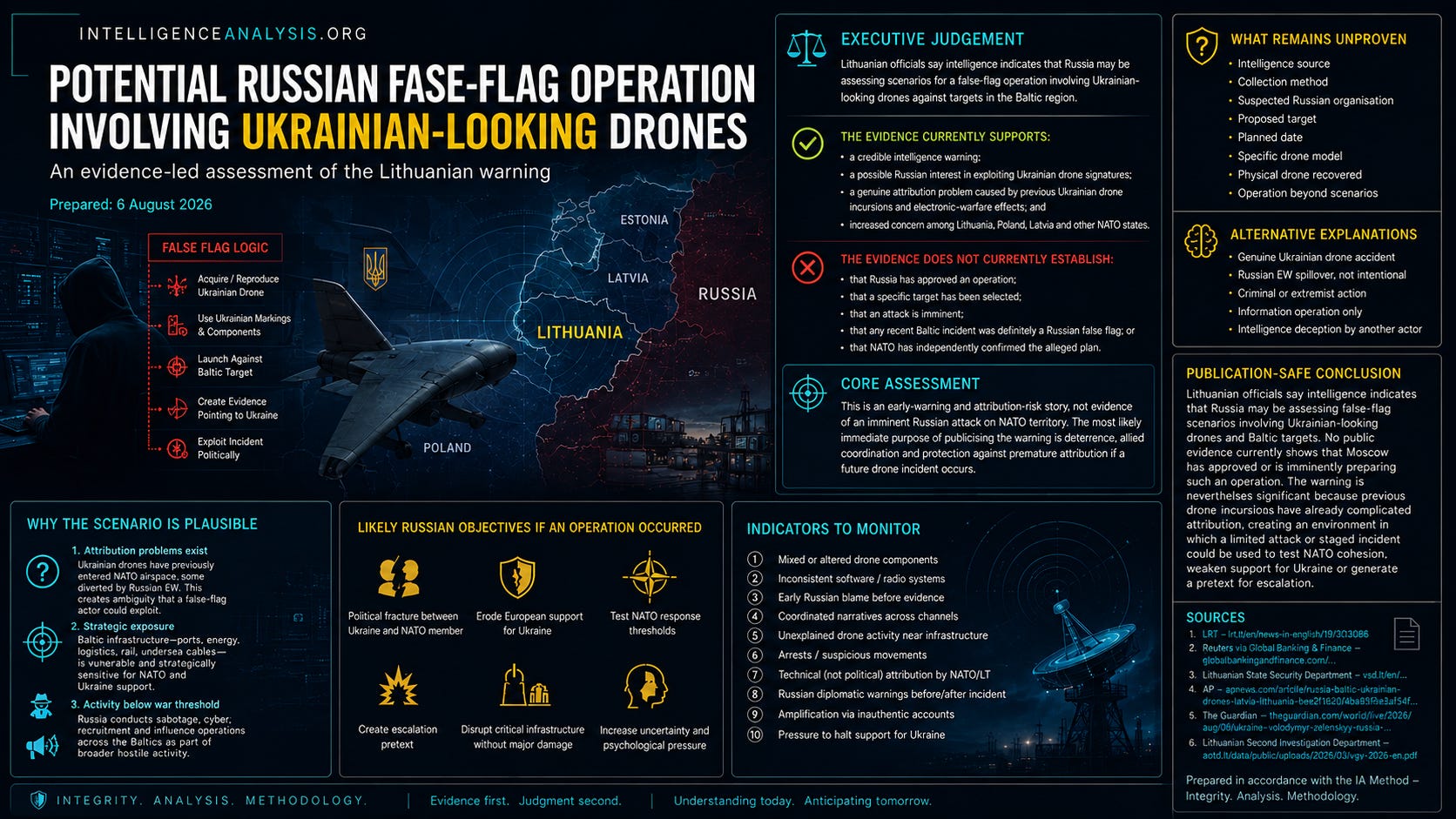
Lithuanian officials say intelligence indicates that Russia may be assessing scenarios for a false-flag operation involving Ukrainian-looking drones against targets in the Baltic region.
The evidence currently supports:
• a credible intelligence warning;
• a possible Russian interest in exploiting Ukrainian drone signatures;
• a genuine attribution problem caused by previous Ukrainian drone incursions and electronic-warfare effects; and
• increased concern among Lithuania, Poland, Latvia and other NATO states.
The evidence does not currently establish:
• that Russia has approved an operation;
• that a specific target has been selected;
• that an attack is imminent;
• that any recent Baltic incident was definitely a Russian false flag; or
• that NATO has independently confirmed the alleged plan.
The core assessment is:
This is an early-warning and attribution-risk story, not evidence of an imminent Russian attack on NATO territory. The most likely immediate purpose of publicising the warning is deterrence, allied coordination and protection against premature attribution if a future drone incident occurs.
WHAT LITHUANIA ACTUALLY SAID
Lithuanian Defence Minister Robertas Kaunas said Lithuanian intelligence had obtained information suggesting that Moscow was considering scenarios involving Ukrainian-made or Ukrainian-looking drones.
According to LRT’s account:
• Russian authorities may be assessing possible operations against Baltic targets;
• a drone could be captured, reconstructed, modified or otherwise made to appear Ukrainian;
• there is no evidence that Russia has made a final decision to conduct such an operation;
• there are no confirmed specific operational plans; and
• Lithuania assesses the risk of a conventional Russian attack on Lithuania as low.
That wording matters. “Considering scenarios” is substantially weaker than “planning an attack.” It indicates an intelligence concern or preparatory assessment, not proof of an authorised operation.
WHAT WOULD MAKE IT A FALSE FLAG?
A false-flag operation is an action deliberately designed to make responsibility appear to belong to a different actor.
In this case, the apparent logic would be:
1. acquire or reproduce a Ukrainian drone design;
2. use Ukrainian markings, components or software;
3. launch the drone against a Baltic target;
4. create evidence pointing towards Ukraine; and
5. exploit the incident politically before forensic attribution is complete.
The intended effect could include weakening European support for Ukraine, creating distrust between Ukraine and NATO members, provoking a political crisis inside the alliance, justifying Russian retaliation, testing NATO’s response threshold, or making future Russian actions appear defensive.
A successful operation would not necessarily require major physical damage. A small attack causing casualties, a fire or a temporary infrastructure shutdown could be enough if the initial evidence appeared to implicate Ukraine.
WHY THE SCENARIO IS PLAUSIBLE
1. Ukrainian drones have already created attribution problems
LRT reported that military drones have repeatedly entered NATO airspace since Russia’s full-scale invasion. Some incidents were attributed to Ukrainian drones that had deviated from course or been affected by Russian electronic warfare.
That creates an evidentiary problem. A drone may be genuinely Ukrainian; Ukrainian but diverted by jamming; a captured or reconstructed Ukrainian design; Russian and deliberately disguised; or simply misidentified during the first hours after an incident.
This ambiguity is precisely what a false-flag actor would seek to exploit.
2. Baltic infrastructure is strategically exposed
Potential targets could include ports, maritime facilities, fuel storage, rail and logistics nodes, power infrastructure, telecommunications, military supply routes, border facilities and undersea or coastal infrastructure.
The Baltic region is particularly sensitive because it connects NATO’s northern and eastern security systems, supports Ukraine-related logistics and sits close to Russia, Belarus and the Suwałki corridor.
3. Russia already conducts activity below the threshold of open war
Lithuania’s State Security Department has warned of Russian intelligence activity, recruitment and operations causing physical damage in Lithuania and other Baltic states.
The Lithuanian intelligence community’s broader threat picture includes sabotage, recruitment, influence operations, cyber activity, disinformation, physical targeting of infrastructure, exploitation of cross-border travel and pressure against support for Ukraine.
The false-flag scenario would fit that broader pattern of activity below the threshold of conventional attack.
4. There is an information environment to exploit
Russia can exploit genuine Ukrainian drone incidents because Ukraine does conduct long-range drone operations against Russian military and energy targets. The existence of real Ukrainian attacks makes fabricated attribution more credible to a casual observer.
A false flag would not need to create a wholly implausible story. It would only need to attach itself to an existing and believable narrative.
WHAT LITHUANIA MAY BE TRYING TO ACHIEVE BY PUBLICISING THE WARNING
Deterrence
If Russia knows Lithuania and its allies are expecting a staged attack, the political value of the operation decreases.
Attribution preparation
The warning encourages NATO states to preserve evidence before making public accusations. Relevant evidence could include wreckage, serial numbers, electronics, flight controllers, firmware, launch routes, radio-frequency data, satellite imagery, radar records and chain-of-custody documentation.
Allied coordination
Lithuania can use the warning to ensure Poland, Latvia, Estonia and NATO command structures share information rapidly after any incident.
Domestic resilience
The public is being told that a future drone event may be part of an influence or sabotage operation. This could reduce panic or retaliatory pressure based on incomplete evidence.
Strategic signalling
The statement signals to Moscow that Lithuanian intelligence is monitoring Russian planning and that a staged attack would not automatically succeed politically.
WHAT REMAINS UNPROVEN
The current evidence does not publicly identify:
• the intelligence source;
• the collection method;
• the suspected Russian organisation;
• the proposed target;
• a planned date;
• a specific drone model;
• whether a physical drone has been recovered;
• whether any operation has moved beyond scenario assessment.
This lack of detail is understandable in an intelligence warning, but it limits independent verification.
The claim should therefore be classified as:
Supported as a public Lithuanian intelligence warning.
Unresolved as an actual Russian operational plan.
Not established as an imminent attack.
PREVIOUS REGIONAL DRONE INCIDENTS
AP reported that stray Ukrainian drones had caused concern in Baltic NATO states and contributed to tensions around airspace security.
Those incidents do not prove Russian responsibility. Their importance is that they create genuine precedent for drone incursions, public uncertainty over attribution, political pressure on Baltic governments and opportunities for manipulation.
The existence of previous Ukrainian drone incursions is therefore a risk factor for deception, not evidence that a future incident would be Ukrainian or Russian.
LIKELY RUSSIAN OBJECTIVES IF AN OPERATION OCCURRED
The most plausible objectives would be:
1. Political fracture: create disagreement between Ukraine and a NATO member over responsibility.
2. Support erosion: encourage European publics to see Ukrainian military activity as a direct threat to their own territory.
3. NATO response testing: measure whether NATO responds collectively, cautiously or in a fragmented way.
4. Escalation pretext: create a narrative that could justify Russian military or covert action.
5. Infrastructure disruption: cause a limited but politically visible attack on energy, transport or military logistics.
6. Psychological pressure: increase uncertainty and make European governments spend more resources protecting infrastructure and airspace.
INDICATORS TO MONITOR
The following would increase confidence that a real operation is being prepared:
1. discovery of drones with mixed or deliberately altered Ukrainian and Russian components;
2. recovered drones carrying inconsistent software, navigation data or radio systems;
3. unusual Russian information activity blaming Ukraine before evidence is released;
4. synchronised narratives across Russian state media and proxy channels;
5. unexplained drone activity near Baltic infrastructure;
6. arrests or suspicious movements involving Russian-linked networks;
7. NATO or Lithuanian authorities issuing technical rather than political attribution;
8. Russian diplomatic warnings appearing before or immediately after an incident;
9. attempts to amplify a Baltic attack claim through multiple inauthentic accounts; and
10. pressure on European governments to halt weapons transfers to Ukraine.
The most important indicator would be pre-positioned narrative activity. If Russian-linked channels begin describing a Ukrainian attack before investigators publish evidence, that could suggest preparation to exploit or manufacture attribution.
ALTERNATIVE EXPLANATIONS
A disciplined assessment must keep competing explanations open:
• genuine Ukrainian drone accident;
• Russian electronic-warfare spillover without a false-flag plan;
• criminal or extremist action;
• an information operation without a physical attack; or
• intelligence deception by another actor seeking to provoke NATO-Russia tension.
The available evidence does not allow these alternatives to be eliminated.
OVERALL ASSESSMENT
The Lithuanian warning should be taken seriously but not sensationalised.
It is best understood as a warning about attribution warfare: who controls the drone, who built it, who launched it, who benefits from the incident, who spreads the first explanation, and who pressures governments to respond before the evidence is complete.
The greatest danger may not be the physical damage from a single drone. It may be the political reaction produced by uncertain attribution.
PUBLICATION-SAFE CONCLUSION
Lithuanian officials say intelligence indicates that Russia may be assessing false-flag scenarios involving Ukrainian-looking drones and Baltic targets. No public evidence currently shows that Moscow has approved or is imminently preparing such an operation. The warning is nevertheless significant because previous drone incursions have already complicated attribution, creating an environment in which a limited attack or staged incident could be used to test NATO cohesion, weaken support for Ukraine or generate a pretext for escalation.
SOURCE NOTE
This report distinguishes public statements, independent reporting and analytical assessment. It does not treat a warning of possible planning as proof of an approved operation or imminent attack.
SOURCES
1. LRT, “Lithuanian intelligence says Russia may use Ukrainian drones to attack Baltic targets”
https://www.lrt.lt/en/news-in-english/19/3013086/lithuanian-intelligence-says-russia-may-use-ukrainian-drones-to-attack-baltic-targets
2. Reuters report syndicated by Global Banking & Finance, “Lithuania warns Russia may use captured Ukrainian drones in Baltic region”
https://www.globalbankingandfinance.com/lithuania-russia-use-ukrainian-drones-against-baltic-region/
3. Lithuanian State Security Department, “How to recognise whether hostile states’ intelligence services target Lithuania or not?”
https://www.vsd.lt/en/threats/how-to-recognise-whether-hostile-states-intelligence-services-target-lithuania-or-not/
4. AP, “Stray Ukrainian drones raise questions about NATO and Baltic security”
https://apnews.com/article/russia-baltic-ukrainian-drones-latvia-lithuania-bee2f1620f4ba958e3af54f4b6bf7f47
5. The Guardian, “Lithuania warns Russia could be considering possible ‘false flag’ strike on the Baltics”
https://www.theguardian.com/world/live/2026/aug/06/ukraine-volodymyr-zelenskyy-russia-nato-germany-leipzig-wildfires-heatwaves-europe-live-news
6. Lithuanian Second Investigation Department, 2026 National Threat Assessment
https://aotd.lt/data/public/uploads/2026/03/vgv-2026-en.pdf
Prepared in accordance with the IA Method — Integrity. Analysis. Methodology.