


Multi-front Overlap
Executive Summary
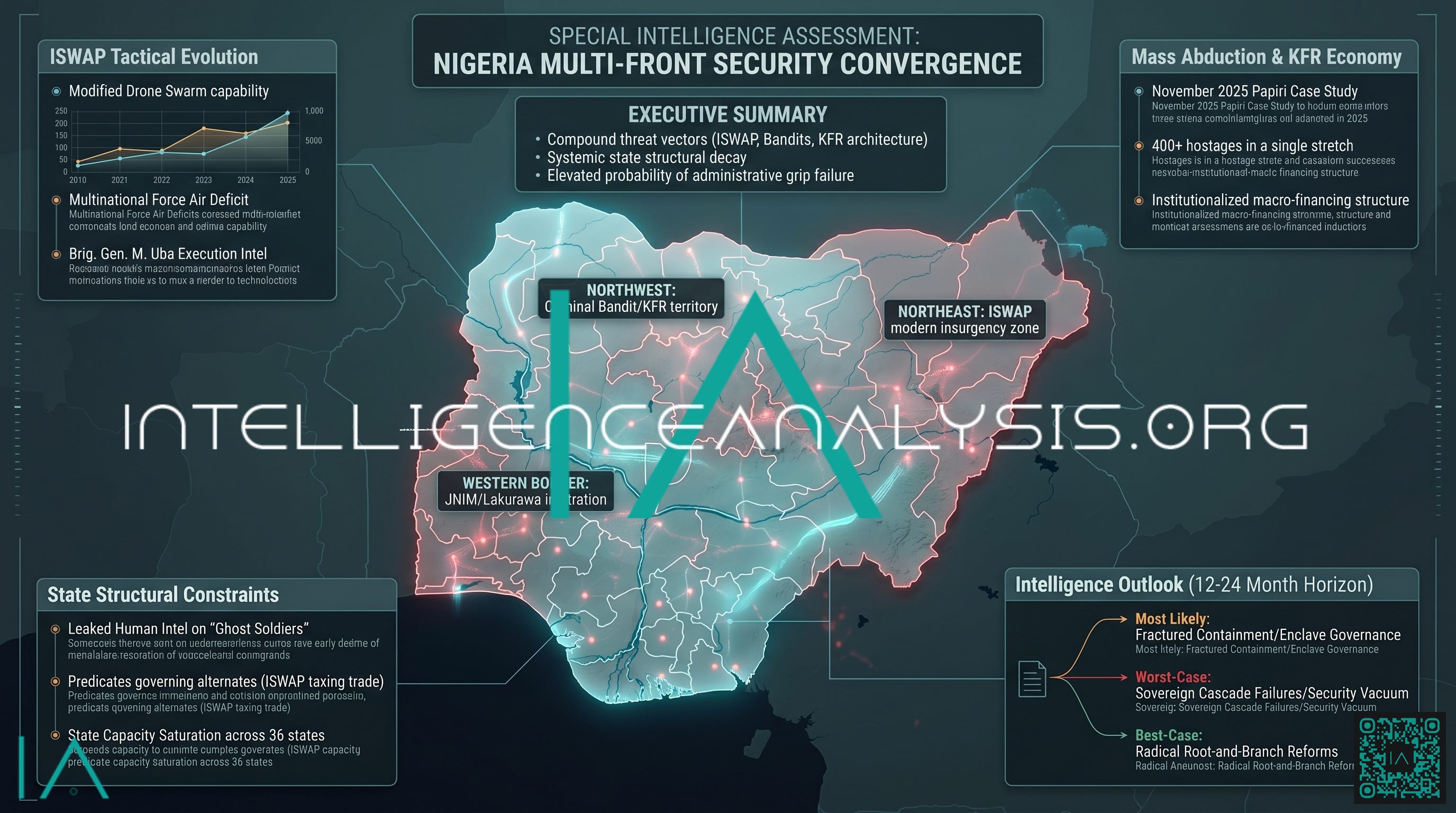
This Special Intelligence Assessment evaluates the compounding structural risks threatening the sovereign integrity of the Federal Republic of Nigeria. Recent data confirms a dangerous convergence of highly capable threat vectors: the technological modernisation of the Islamic State West Africa Province (ISWAP), the return of mass-scale kidnapping for ransom (KFR) as an institutionalised financing mechanism, and systemic structural decay within the state security apparatus. These fronts are no longer isolated regional disturbances; they operate as a stacked, reinforcing circuit. Without immediate tactical pivots and structural reforms, the Nigerian state faces an elevated probability of losing administrative grip over critical northern sectors within the 12-to-24-month horizon.
1. The Tactical and Technological Evolution of ISWAP
The Islamic State West Africa Province (ISWAP) has completed a fundamental pivot from a localised, asymmetric insurgent group to a more disciplined, technologically capable force. This shift was starkly illustrated during the ‘Camp Holocaust’ operational campaign in the Lake Chad Basin, which significantly altered the military status quo in the Northeast.
Commercial Drone Proliferation & Air Deficit
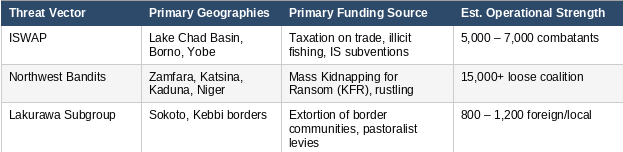
ISWAP has successfully weaponised commercially available enterprise drones, retrofitting them with release mechanisms for explosive payloads. The first confirmed instance of combat drone use in the region occurred on 24 December 2024, when ISWAP deployed four armed drones carrying locally made grenades against Nigeria’s Forward Operating Base Wajiroko in Damboa, injuring at least five soldiers. Subsequent drone attacks followed in Damaturu (Yobe State) and Abadam on Lake Chad. By early 2026, ISWAP had reportedly received a fresh supply of approximately 35 additional UAVs transported via the Lake Chad corridor, and intelligence assessments indicated plans for coordinated simultaneous drone strikes against military positions in Borno and Yobe states. The Multinational Joint Task Force (MNJTF) has reported significant deficits in tactical electronic jamming and counter-unmanned aerial systems (C-UAS) equipment to counter these capabilities.
Command Attrition: The Killing of Brigadier General Musa Uba
The operational reach of ISWAP was demonstrated on 14 November 2025 during the killing of Brigadier General Musa Uba, Commander of the 25 Task Force Brigade in Damboa local government area, Borno State. [CORRECTION: The original report incorrectly stated he was the Brigade Commander in Benishekh.] Uba led a routine patrol alongside Civilian Joint Task Force (CJTF) members into an ISWAP-dominated area near Wajiroko village, where his convoy was ambushed. Four personnel, two soldiers and two CJTF members, were killed in the initial engagement. Uba survived the initial attack and, having become separated from his forces, began coordinating his rescue via personal WhatsApp messages to military authorities. Despite helicopter search efforts, he could not be located. Three days later, ISWAP announced via its Amaq propaganda channel that it had captured and executed him after interrogation. His death represented the most senior Nigerian military officer killed since 2021, and has been followed by a series of further command-level losses in early 2026.
2. Mass Abductions and Kidnapping for Ransom (KFR) Architecture
In late 2025 and continuing into 2026, mass abductions have returned to northern Nigeria at a scale that eclipses historical benchmarks. These actions represent an institutionalised macro-economy of regional destabilisation, no longer the work of uncoordinated gangs.
The Papiri Case Study and Scale Benchmarks
The most significant incident occurred on 21 November 2025, when heavily armed gunmen stormed St. Mary’s Catholic Primary and Secondary Boarding School in Papiri, Agwara local government area, Niger State, abducting 303 students and 12 faculty members, 315 victims in total. The attack began at approximately 2:00 a.m. and overwhelmed local security. Around 50 students escaped in the immediate aftermath and were reunited with their families. The attack occurred during a single week in which cascading raids across northern states, including an attack on a school in Kebbi State that seized 25 schoolgirls on 18 November, pushed the monthly abduction total past 400 individuals. A sustained intelligence and negotiation operation resulted in the phased release of the remaining hostages, with the final batch of 130 freed on 21 December 2025, and all hostages ultimately accounted for.
3. Structural Constraints of the State Security Apparatus
The failure to contain these overlapping threats stems from fundamental structural vulnerabilities within the Nigerian Armed Forces and state bureaucracy. These issues hollow out the capabilities of front-line units, preventing effective force projection.
The ‘Ghost Soldier’ Phenomenon
Human intelligence and audits indicate that actual combat-ready troop numbers in frontline zones are significantly lower than official rosters suggest. Corrupt command elements have routinely drawn salaries, equipment allocations, and field allowances for non-existent personnel, leaving units severely undermanned when facing concentrated assaults.
Predatory Governing Alternates
Armed non-state actors are successfully competing with the state for sovereign authority. Northwestern criminal syndicates have extracted very substantial cumulative ransoms from communities, while ISWAP functions as a pseudo-state by imposing predictability through informal taxation systems on local trade.
The Multi-Front Convergence
The state is experiencing a saturation of its defensive capacity, with the military simultaneously deployed across approximately two-thirds of Nigeria’s 36 states on internal security duties: against ISWAP in the Northeast, criminal syndicates in the Northwest, and the newly emerged Lakurawa in Sokoto. Separately, JNIM. the Al-Qaeda-affiliated Sahelian group, claimed responsibility for an attack on a Nigerian military patrol in Kwara State in October 2025, apparently marking its first confirmed incursion into Nigerian territory.
4. Intelligence Outlook and Scenarios
As the signals stack, the operational trajectory suggests three primary pathways for the medium-term horizon:
Most Likely Scenario: Fractured Containment and Enclave Governance
The state maintains control over major urban centres and capitals but yields physical control of rural interiors to non-state actors. ISWAP consolidates its proto-state infrastructure around the Lake Chad Basin, while bandit networks segment the Northwest into localised fiefdoms. The national economy suffers under the weight of continuous ransoms, increasing dependence on external aid.
Best-Case Scenario: Root-and-Branch Anti-Corruption and Modernisation
Rigorous defence procurement reform eliminates ‘ghost soldier’ salary leaks and reallocates resources toward tactical acquisition. Integration of counter-drone jamming technologies, paired with localised community policing, suppresses bandit networks. Increased regional coordination successfully constrains ISWAP’s logistics.
Worst-Case Scenario: Sovereign Cascade Failures
A major economic shock further diminishes the federal budget, causing recruitment to fail to match attrition. ISWAP, Lakurawa, and bandit groups establish transactional tactical pacts, launching coordinated offensives on major cities. Security forces suffer a cascading collapse in morale, prompting withdrawal to urban enclaves and creating an unprecedented security vacuum.
