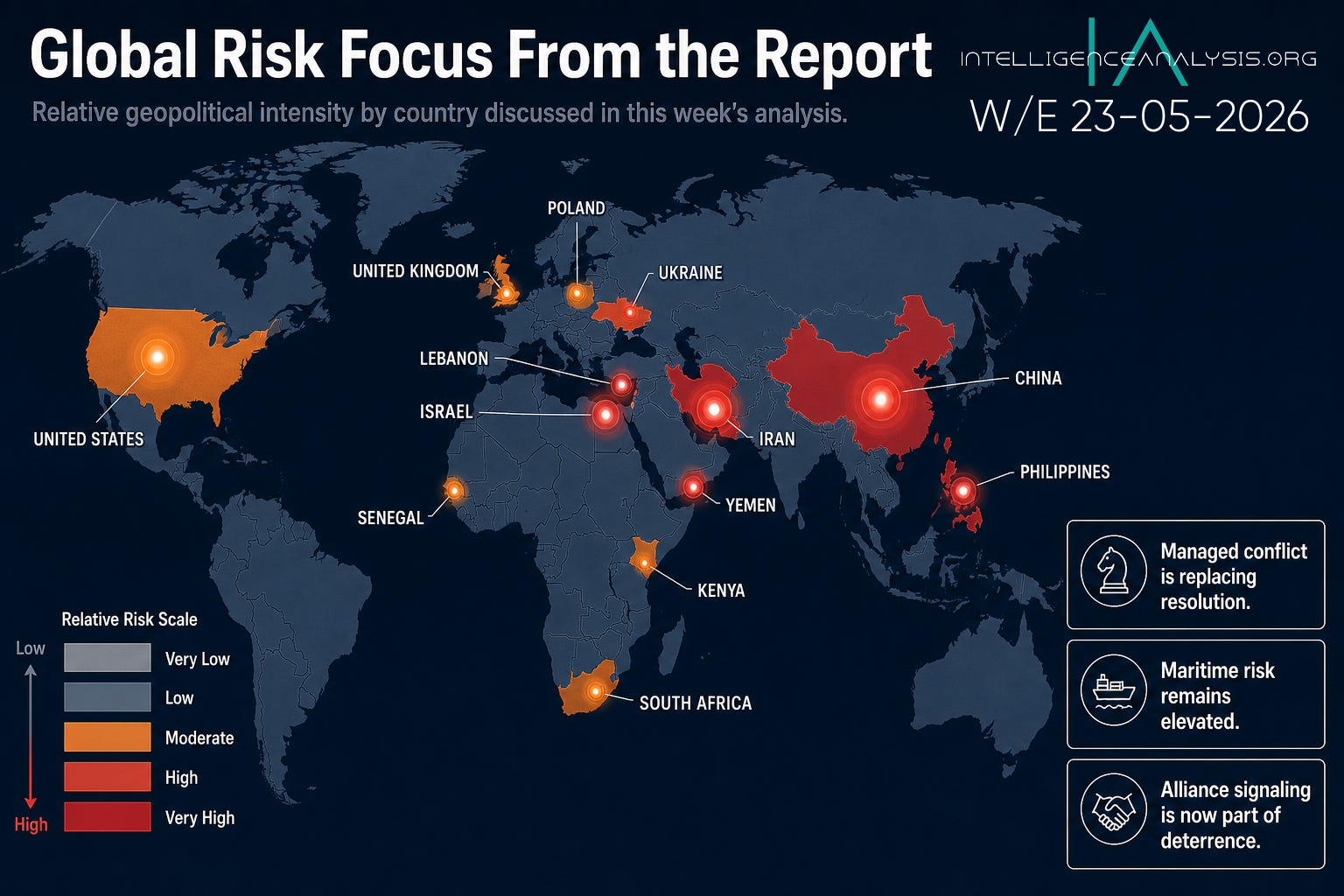
Since publication of the weekly report, the strategic picture has tightened rather than fundamentally changed. The central pattern remains bargaining under pressure, but the week’s interim developments suggest that the margin for controlled de-escalation may be narrowing. On the Iran file, the key update is that diplomacy is still active, but it continues to operate inside a framework of explicit military threat and short decision timelines. On the Russia-Ukraine front, the significance of refinery strikes has grown as reporting around Russian energy ties with China highlights how energy infrastructure damage now intersects directly with Moscow’s external economic resilience. On the U.S.-China track, Beijing’s role is becoming more important not just as a trade counterpart but as a geopolitical balancer across the Iran and Russia files. The cumulative effect is a more entangled risk environment in which regional crises are increasingly linked through energy, diplomacy, and strategic hedging.
What Changed Since The Weekly Report
The Iran issue remains unresolved, but the diplomatic window is still open. Public signaling from Washington continues to mix the prospect of a deal with reminders that military action can resume quickly.
China’s role in the Iran crisis is now more clearly strategic. Beijing has publicly emphasized the need to maintain the ceasefire and keep the Strait of Hormuz open, indicating that Chinese economic exposure is shaping its diplomatic posture.
Russia’s energy relationship with China has taken on greater significance. Russian oil exports to China reportedly rose sharply in the first quarter, reinforcing the idea that Moscow’s external resilience increasingly depends on Asian energy demand.
The next phase of risk is becoming more interconnected. Developments in the Gulf, the Russia-Ukraine war, and U.S.-China diplomacy are no longer best understood as separate stories.
Iran And The Gulf
The most important mid-week judgment is that the Iran file has entered a more delicate phase. The original weekly report argued that Washington had reached the practical limits of coercive diplomacy without a clear off-ramp. That assessment still holds. What has changed is that the diplomatic pause now looks more explicitly tied to outside actors and market-sensitive constraints than it did earlier in the week.
Thanks for reading! Subscribe for free to receive new posts and support my work.
China has publicly stressed the urgent need to preserve the ceasefire and reopen or maintain access through the Strait of Hormuz. That matters because it confirms that Beijing views the Gulf crisis not only as a distant security issue but as a direct economic threat. Hormuz is a strategic chokepoint for energy flows, and Chinese concern about its status indicates that the commercial implications of any renewed U.S.-Iran confrontation are influencing great-power diplomacy more directly.
This creates a more layered negotiation. Washington is not only bargaining with Tehran. It is doing so in a context where major importers, especially China, have incentives to prevent another disruption in Gulf energy transit. That does not mean Beijing can dictate the outcome. It does mean any further U.S. escalation would carry broader economic and diplomatic costs than a purely bilateral reading would suggest.
The second-order implication is that the Iran issue is becoming more internationalized through energy dependence rather than formal alliance politics. That should matter to policymakers and businesses alike. Oil traders, insurers, shipping firms, and governments are increasingly watching the same indicator set: not only whether a deal is signed, but whether the ceasefire logic still holds.
Russia, Ukraine, And Energy Resilience
The weekly report highlighted Ukrainian strikes on Russian refining infrastructure as a strategically important trend. Mid-week developments reinforce that view. The longer this pattern continues, the more the question shifts from whether such strikes are symbolically effective to whether they are materially degrading Russia’s war-supporting systems.
A key reason this now matters more is Russia’s growing energy dependence on China as an external buyer. Recent reporting indicates that Russian oil exports to China rose significantly in the first quarter of 2026. That does not negate the damage caused by refinery disruptions, but it does sharpen the strategic picture. Moscow’s resilience increasingly rests on its ability to keep energy flowing eastward even as domestic infrastructure comes under attack.
This creates an important tension. On one side, Ukraine is trying to widen the war’s economic depth by increasing the cost and complexity of Russian energy operations. On the other, Russia is relying more heavily on external demand, especially from China, to cushion economic pressure. The war is therefore becoming more tightly connected to Asia’s energy and industrial landscape.
For European and business audiences, the practical lesson is that refinery strikes should not be read only as battlefield-adjacent events. They now sit inside a wider contest involving sanctions endurance, export rerouting, repair capacity, and foreign energy demand. In short, infrastructure vulnerability and market adaptation are now part of the same strategic equation.
China’s Expanding Strategic Role
The most notable mid-week evolution is the extent to which China now sits near the center of all three major stories covered in the weekly report.
First, Beijing has a direct stake in Gulf stability because of its exposure to maritime energy flows and the Strait of Hormuz. Second, it remains a critical economic absorber of Russian energy exports. Third, it is simultaneously engaged with Washington in a transactional but consequential trade relationship. This means China is no longer just one regional variable among many. It is functioning as a cross-theater stabilizer, stakeholder, and hedge.
That does not mean China is acting as a neutral mediator. Its interests are selective and self-protective. Beijing wants energy access, manageable U.S. relations, and continued strategic room to maneuver. But the important analytical point is that Chinese preferences now affect multiple crisis theaters at once.
This matters for the United States. Any attempt by Washington to compartmentalize Iran, Ukraine, and trade policy will become harder if Beijing’s economic interests continue to connect these theaters. It matters for Europe as well, because European policymakers increasingly operate in an environment where Russia policy, China exposure, and Middle East energy security cannot be separated as cleanly as before.
Strategic Implications
Several implications now stand out more clearly than they did at the start of the week.
Geopolitical theaters are increasingly linked through energy systems and trade flows.
China’s role as an economic stakeholder is giving it more indirect geopolitical influence across multiple crises.
Temporary diplomatic pauses may reduce immediate risk, but they do not remove structural instability.
Energy infrastructure remains one of the most important leverage points in modern conflict.
Businesses should continue planning for volatility in shipping, insurance, fuel pricing, and supply chain timing rather than waiting for formal escalation.
The broader strategic takeaway is that mid-week developments have made the original report’s core argument more compelling, not less. The world is being managed through pressure, but the pressure itself is now more interconnected. That raises the likelihood that developments in one theater will have faster consequences in another.
What To Watch Before Week’s End
Whether U.S.-Iran diplomacy produces a clearer interim framework or drifts back toward overt military signaling.
Whether China increases its public diplomatic engagement on Gulf stability and Hormuz access.
Whether more evidence emerges of cumulative stress on Russian refining or export systems.
Whether U.S.-China engagement broadens beyond trade optics into more explicit coordination, or disagreement, on Iran and other strategic issues.
Whether market participants begin more visibly repricing interconnected energy and geopolitical risk.
Podcast Add-On Segment
This mid-week insert can be added after the opening segment of the main podcast episode.
Key speaking points:
The basic structure of the week has not changed, but the connections between theaters are becoming clearer.
Iran remains the most immediate escalation risk, yet the diplomatic pause is being shaped by wider energy and trade considerations.
Russia’s vulnerability is increasingly tied to how well it can sustain energy exports to China while defending domestic infrastructure.
China now matters across all three stories, not only as a major power, but as the economic hinge linking Gulf stability, Russian resilience, and U.S. strategic competition.
The most important update is not a single new event. It is the growing interdependence of what previously looked like separate crises.