

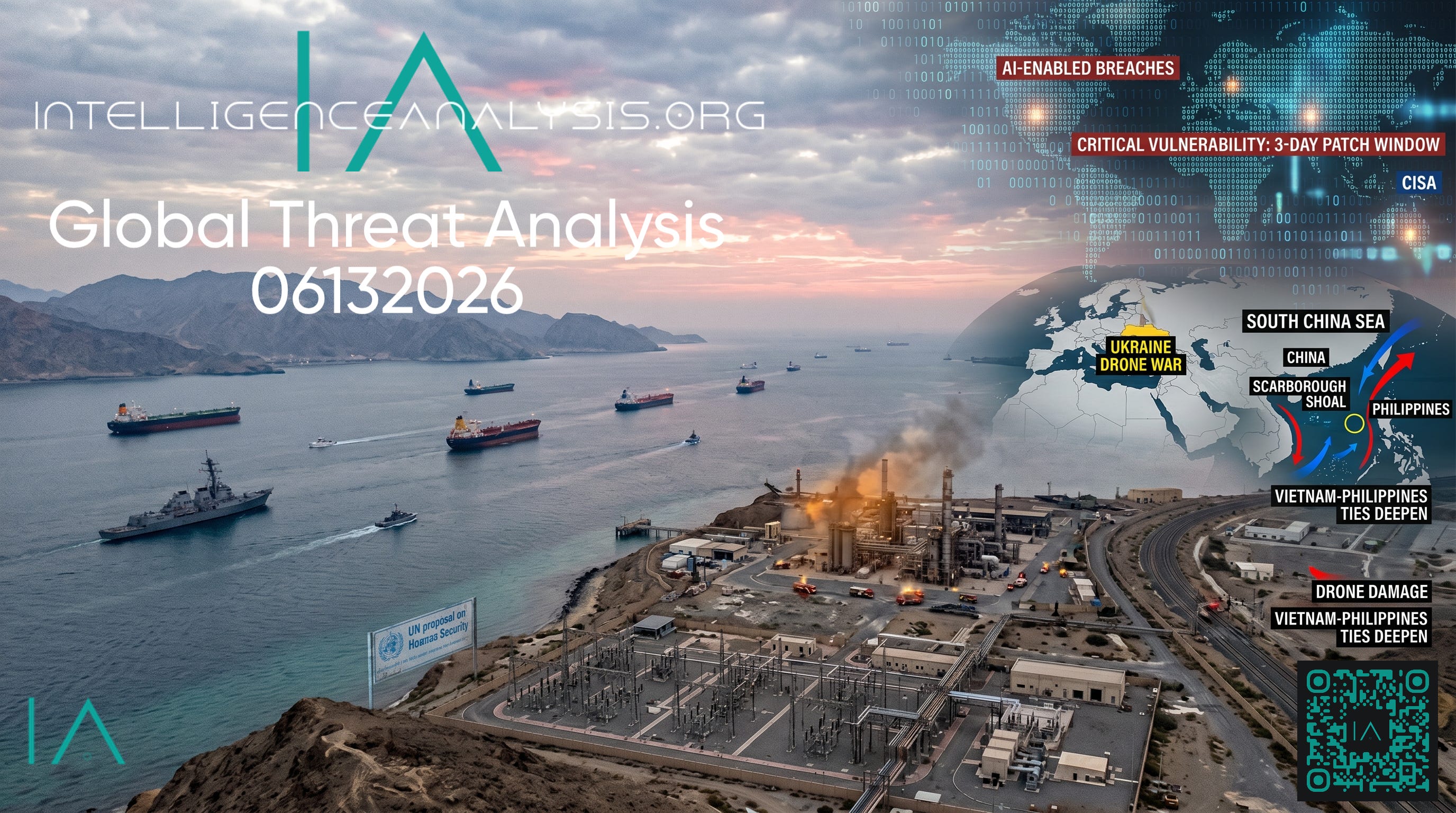
Welcome to this weeks Global Threat Analysis from INTELLIGENCEANALYSIS.ORG. Between 7 June and 13 June 2026, the most important shift has been the convergence of kinetic conflict, maritime coercion, and cyber risk into a more connected threat environment. The centre of gravity remains the Middle East, where Reuters reported that the United States and Iran were close to signing an agreement to end their war, even as hostilities and oil-market volatility continued to shape the strategic picture. In parallel, Russia kept up pressure on Ukraine with drone and missile strikes, while the South China Sea remained a theatre of incremental but consequential coercion as China and the Philippines clashed over disputed features. The result is a week in which risk has not simply increased, but become more interdependent across energy, shipping, cyber defence, and alliance politics.
Top Developments This Week
The Iran crisis remained the main driver of global risk. Reuters said Washington and Tehran were close to a framework for ending the war, but the reporting also showed how fragile that process remained, with later updates indicating timing uncertainty around the signing of related memoranda. The market response was immediate, with Reuters noting that oil prices rose and global shares fell as hopes for a swift end to the conflict faded.
Maritime security intensified in the Strait of Hormuz and adjacent waters. AP reported on efforts to secure the strait through a watered-down UN proposal, highlighting the gap between diplomatic language and operational maritime protection. This matters because even partial interference in Hormuz can ripple through global energy pricing, tanker routing, insurance costs, and port risk assessments.
Cyber defence moved onto a shorter clock. Reuters reported that CISA shortened the window for fixing the most critical vulnerabilities in U.S. civilian federal systems to three days, explicitly linking the change to the pace of AI-enabled attacks. A separate Reuters report said AI-related data breaches had overtaken stolen credentials as an initial breach vector, underlining that the cyber threat is shifting from opportunistic intrusion to faster, more adaptive exploitation.
Ukraine remained strategically active despite battlefield strain. Reuters said Russian and Ukrainian forces exchanged overnight drone strikes, with attacks hitting refineries, petrochemical facilities, railway stations, and electrical substations. That pattern shows a war that is increasingly about degrading industrial capacity and transport resilience, not only territorial gain.
The South China Sea saw more calibrated coercion. Reuters reported that the Philippines formally challenged China over a structure near Scarborough Shoal, while separately Manila and Hanoi deepened ties and reaffirmed freedom of navigation as non-negotiable. The significance is not a dramatic escalation, but a steady hardening of regional alignments against maritime pressure.
Russia kept its hardline narrative intact. Reuters reported that Vladimir Putin remained publicly committed to victory while suggesting negotiations could only work on Moscow’s terms. That stance limits the room for rapid de-escalation in Ukraine and indicates the Kremlin still sees the war as politically sustainable.
Regional Analysis
Middle East
The Middle East was the week’s principal shock absorber and shock source at the same time. Reuters reported that the United States and Iran were close to signing an agreement to end their war, but the reporting also made clear that the diplomatic track remained fragile and time-sensitive. Even the prospect of de-escalation is now part of the risk premium, because markets, shipping firms, and regional governments are all planning for the possibility of renewed violence rather than assuming a stable settlement.
The Strait of Hormuz remains the key hinge. AP’s reporting on a diluted UN proposal to secure the strait suggests that governments recognise the risk, but still lack consensus on a credible enforcement architecture. That matters because any interruption there would affect not only Gulf energy exports but also Asia-bound supply chains, insurance costs, and naval posture. The second-order effect is that more states will likely invest in contingency routing, escort arrangements, and stockpile planning even if no formal closure occurs.
Eastern Europe
Ukraine remained a zone of attritional pressure, with Reuters documenting reciprocal drone strikes against energy and transport infrastructure. The strategic implication is that Russia appears to be targeting systems that support military logistics and civilian resilience at the same time. That is consistent with a campaign designed to stretch Ukrainian defence resources while eroding public endurance.
Putin’s public line remained uncompromising. He presented battlefield progress as continuing and framed negotiations as conditional on Ukrainian acceptance of Russian terms. That posture reduces the probability of a near-term breakthrough and keeps pressure on European governments to sustain military aid, energy resilience, and industrial mobilisation.
East Asia
The South China Sea continued to move by inches, not miles, but those inches matter. Reuters reported Philippine diplomatic action against China after the appearance of a structure near Scarborough Shoal, and also reported a renewed standoff between Chinese and Taiwanese coast guard forces near the Pratas Islands. These incidents are operationally modest, but they reinforce a pattern of persistent maritime pressure below the threshold of open conflict.
Manila and Hanoi’s upgraded relationship is strategically relevant because it reflects regional hedging against coercion. The fact that two claimant states are now talking more explicitly about maritime law and freedom of navigation suggests a slow-building counterweight to Chinese pressure. The risk is not immediate war, but normalised friction that increases the chances of miscalculation, interception, or accidental escalation.
North America
In North America, the most important development was cyber policy tightening rather than a single attack event. Reuters reported that CISA compressed the remediation window for critical vulnerabilities, which is a strong signal that U.S. officials now expect faster exploitation cycles, including by AI-enabled adversaries. That will have implications for federal agencies, contractors, and critical infrastructure operators that depend on long patch cycles and layered approval processes.
This also matters beyond the United States. When Washington changes its cyber tempo, allied governments and private sector operators tend to recalibrate their own expectations. The practical effect is a wider move toward continuous vulnerability management, more aggressive segmentation, and faster incident response planning.
Cybersecurity
Cyber risk is now tightly coupled to geopolitics rather than standing apart from it. Reuters said AI-related breaches have surpassed credential theft as an initial attack vector, which suggests attackers are finding vulnerabilities faster and using automation to scale intrusion attempts. That changes the economics of defence because response time, rather than just perimeter strength, becomes decisive.
The CISA directive reinforces that same trend. The implication for businesses is clear: the threat model is no longer only about protecting data, but about protecting uptime, safety, and operational continuity. For governments, it means that cyber readiness increasingly functions as national resilience policy.
Maritime Security
The maritime picture was shaped by three overlapping pressures: Hormuz, the South China Sea, and the broader risk of shipping disruption tied to conflict. Even when vessels are not physically attacked, the effect of standoffs, diplomatic notes, and security advisories is to raise costs and narrow routing options. That is why maritime security now sits at the centre of economic risk analysis, not just naval planning.
The biggest second-order effect is insurance behaviour. When insurers perceive a corridor as unstable, premiums rise quickly, and that cost spreads to freight rates, inventories, and retail pricing. Even limited confrontation can therefore become a macroeconomic issue.
Strategic Implications
This week underlined that the most important threat is not a single war or one region, but the interaction between them. Energy shock, cyber disruption, and maritime friction are feeding one another. That makes the global environment less forgiving of error and more sensitive to miscommunication, slow decision-making, or partial intelligence.
For governments, the lesson is to plan for simultaneous rather than sequential crises. A maritime disruption in the Gulf, a cyber incident in critical infrastructure, and renewed pressure in the Black Sea or South China Sea could all occur at the same time. That would strain diplomatic bandwidth, military readiness, and market confidence.
For business, the implication is that resilience must be multi-domain. Supply chains need to account for shipping delay, cyber outage, sanctions exposure, and energy volatility together. Firms that treat these as separate issues will under-prepare; firms that integrate them into one risk framework will be better positioned.
What to Watch Next
Whether the US-Iran diplomatic track produces a signed framework or slips again, which would affect oil, shipping, and regional force posture.[reuters]
Whether attacks or threats in or around the Strait of Hormuz intensify, especially if navies move from deterrence to escort operations.[apnews]
Whether Ukraine and Russia continue targeting energy and rail infrastructure, which would indicate a deeper campaign against economic endurance.[reuters]
Whether the Philippines, Vietnam, and other Southeast Asian states deepen coordinated maritime signalling against China.[internazionale]
Whether more governments adopt compressed cyber remediation timelines in response to faster AI-enabled exploitation.[reuters]
Whether a new shipping disruption, sanctions move, or retaliatory cyber event causes a broader market repricing.[reuters]
Sources and Links
Reuters, US-Iran peace framework reporting[reuters]
Reuters, Hormuz and related Middle East updates[reuters]
Reuters, oil and market reaction to Middle East unrest[reuters]
AP News, Strait of Hormuz proposal[apnews]
Reuters, CISA three-day cyber fix window[reuters]
Reuters, AI-related breaches and Verizon report[reuters]
Reuters, Ukraine drone and infrastructure strikes[reuters]
Reuters, Putin on Ukraine and negotiations[reuters]
Reuters, Philippines and Scarborough Shoal[reuters]
Reuters, Pratas Islands standoff[internazionale]
Reuters, Philippines-Vietnam maritime partnership[internazionale]
DOWNLOAD RESOURCES FOR THIS REPORT
